
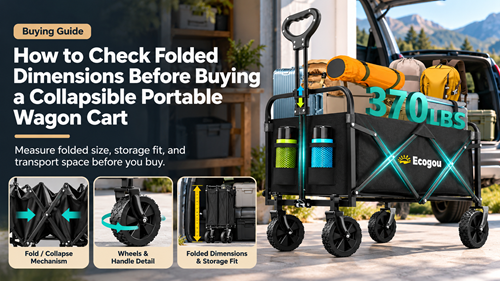

A Collapsible Portable Wagon Cart can save storage space only when its folded dimensions actually fit the place where you plan to keep it. Overall open capacity attracts attention, but trunk height, shed depth, folded wheel position, handle shape, and the way the frame locks together determine whether the cart is convenient between uses.
Before ordering, measure the storage location and the route to it. A wagon that fits inside a garage can still be awkward if the folded wheels catch a narrow doorway or the handle projects beyond a shelf. This guide keeps the decision focused on real dimensions instead of assuming that every foldable cart becomes equally compact.
How to Evaluate Collapsible Portable Wagon Cart
Start with the exact space available in the trunk, shed, closet, or garage corner. Measure the opening as well as the interior because a wide folded frame can clear the storage area but fail at the doorway.
Compare folded dimensions with the cart’s weight. A compact cart may still be inconvenient if it must be lifted high into a vehicle or carried across stairs.
Check what must be removed or adjusted before folding. Cup holders, shelves, liners, and telescoping handles can change the real storage routine.
Collapsible Portable Wagon Cart decisions are easiest to defend when the product is tested against the exact space, material, plant, or route described above rather than a generic maximum claim.
Six Buying Checks That Matter
Measure the Folded Footprint
When comparing folded wagon size, Compare the published folded length, width, and height with your measured space. A single “compact” claim does not show which side becomes the limiting dimension.
Add a few inches of handling clearance so fingers, wheels, and the frame do not scrape walls or vehicle trim every time the wagon is stored.
Plan the Storage Position
When comparing compact wagon storage, Decide whether the wagon will stand upright, lean against a wall, or lie flat. Upright storage saves floor space only when the base is stable and the wheels do not roll.
If the cart must lie flat, check whether the folded handle or wheel hubs create pressure points under other stored items.
Test Car-Trunk Clearance
When comparing foldable wagon for car trunk, Measure the trunk opening at its narrowest point and compare it with the folded frame rather than only the cargo-bay dimensions.
Remember that loading angle matters. A cart that fits once inside may still require awkward twisting to clear the hatch or bumper.
Compare Dimensions Consistently
When comparing wagon storage dimensions, Use the same orientation for every cart comparison. Length, width, and height are easy to misread when one manufacturer measures with the handle collapsed and another includes wheel projections.
Confirm whether the published dimensions include accessories, canopy hardware, or removable trays before making a final fit decision.
Check Portable Size Against Weight
When comparing portable wagon folded size, A small folded package can still be heavy. Compare the folded size with lifting weight and where the strongest handholds are located.
If the wagon will be moved frequently, a slightly larger folded cart may be easier to manage when it has better balance or a locking carry handle.
Protect Small-Garage Space
When comparing wagon for small garage, In a small garage, storage must coexist with doors, shelving, bicycles, and walking paths. Mark the wagon footprint on the floor before buying.
Keep enough clearance that the cart can be removed without moving several other items first; otherwise the space-saving design will not save much time.
Where It Fits Best
A side-by-side task check is more useful than a generic “best for everyone” verdict. Use the table below to match the product to normal work and then verify the current product instructions before use.
| Situation | Practical Fit | What to Watch |
|---|---|---|
| Apartment closet | Upright folded cart | Stable base and clean wheels |
| Car trunk | Low folded height | Hatch opening and lift weight |
| Small shed | Narrow footprint | Door width and damp storage |
| Garage shelf | Flat folded frame | Shelf depth and load rating |
| Wall corner | Vertical storage | Wheel lock and handle projection |
| Frequent travel | Fast folding mechanism | No loose removable parts |
The table is intentionally conservative. The most reliable decision comes from matching the product to normal work rather than chasing the maximum capacity, longest reach, highest piece count, or strongest claim.
A Better Real-World Routine
Set up the work area before the first full task. Confirm the route, container, plant, soil condition, or material involved and use a light test first so fit and control can be checked without committing to the hardest job.
Keep a simple record of what worked: tool size, load, application amount, storage position, or setup. Repeatable decisions make future purchases and maintenance easier.
Before Each Use
- Measure the storage opening
- Measure usable interior depth
- Check folded wheel position
- Confirm handle position
- Compare cart weight
- Allow lifting clearance
- Check standing stability
- Plan where accessories will go
A repeatable routine makes comparison easier. Saving steps, improving control, or keeping a messy task organized without creating another problem are more meaningful advantages than a long list of secondary features.
Care, Storage, and Practical Limits
Keep fabric and frame dry before long-term storage, remove soil from wheel hubs, and avoid forcing the folding joints when debris is trapped in the mechanism.
For broader technique and safety context, review Penn State Extension guidance on choosing tools that fit the user and task. Always give the current product label, manual, or manufacturer instructions priority for rates, loads, assembly, cleaning, storage, and replacement parts.
Who Should Choose It
This setup suits gardeners who transport tools, soil bags, plants, or groceries but have limited storage in a vehicle, shed, apartment, or shared garage.
A good purchase should reduce friction in the garden routine. If another product type solves the task with fewer compromises, choose that alternative instead of paying for features you will not use.
Final Buying Takeaway
A Collapsible Portable Wagon Cart should be chosen from the storage space backward. Open capacity matters only after the folded frame can be stored and handled without creating a new problem.
Collapsible Portable Wagon Cart should be treated as a practical tool or product choice: verify current specifications, use the first few sessions as a test period, and keep the setup that remains controlled, easy to maintain, and consistent.
Frequently Asked Questions
What folded dimension matters most?
The limiting dimension depends on the storage opening and orientation. Measure length, width, and height rather than choosing by one number.
Can a folded wagon stand upright?
Some can, but verify the manufacturer instructions and make sure the wheels or frame cannot roll or tip.
Should I measure the trunk opening or the trunk interior?
Measure both. The cart must pass through the hatch opening before the interior space matters.
Does a smaller folded wagon always weigh less?
No. Frame materials, wheels, and capacity can make a compact cart heavier than expected.
How much clearance should I leave?
Leave enough room to grip and lift the cart without rubbing walls, shelves, or vehicle trim.
