
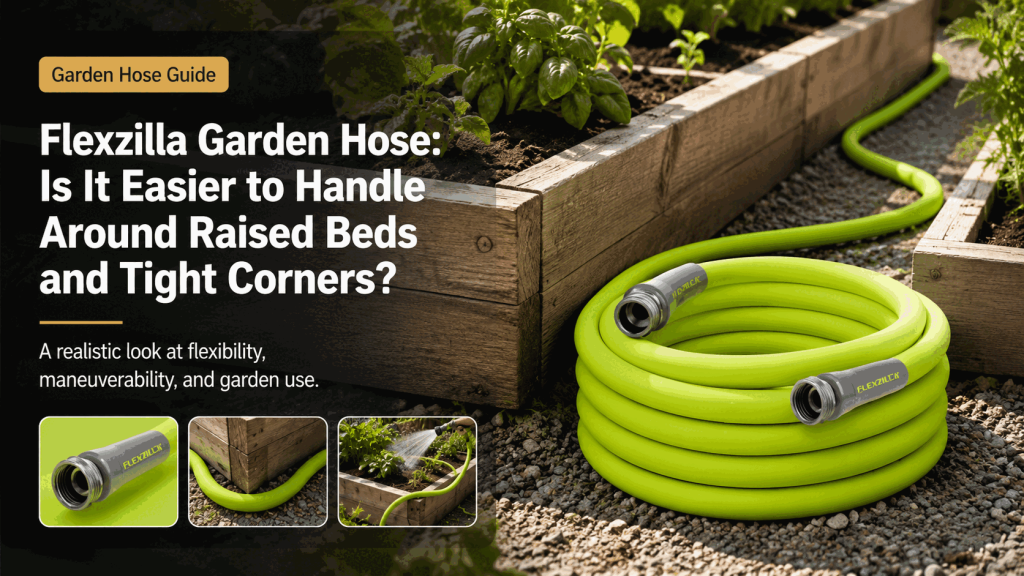
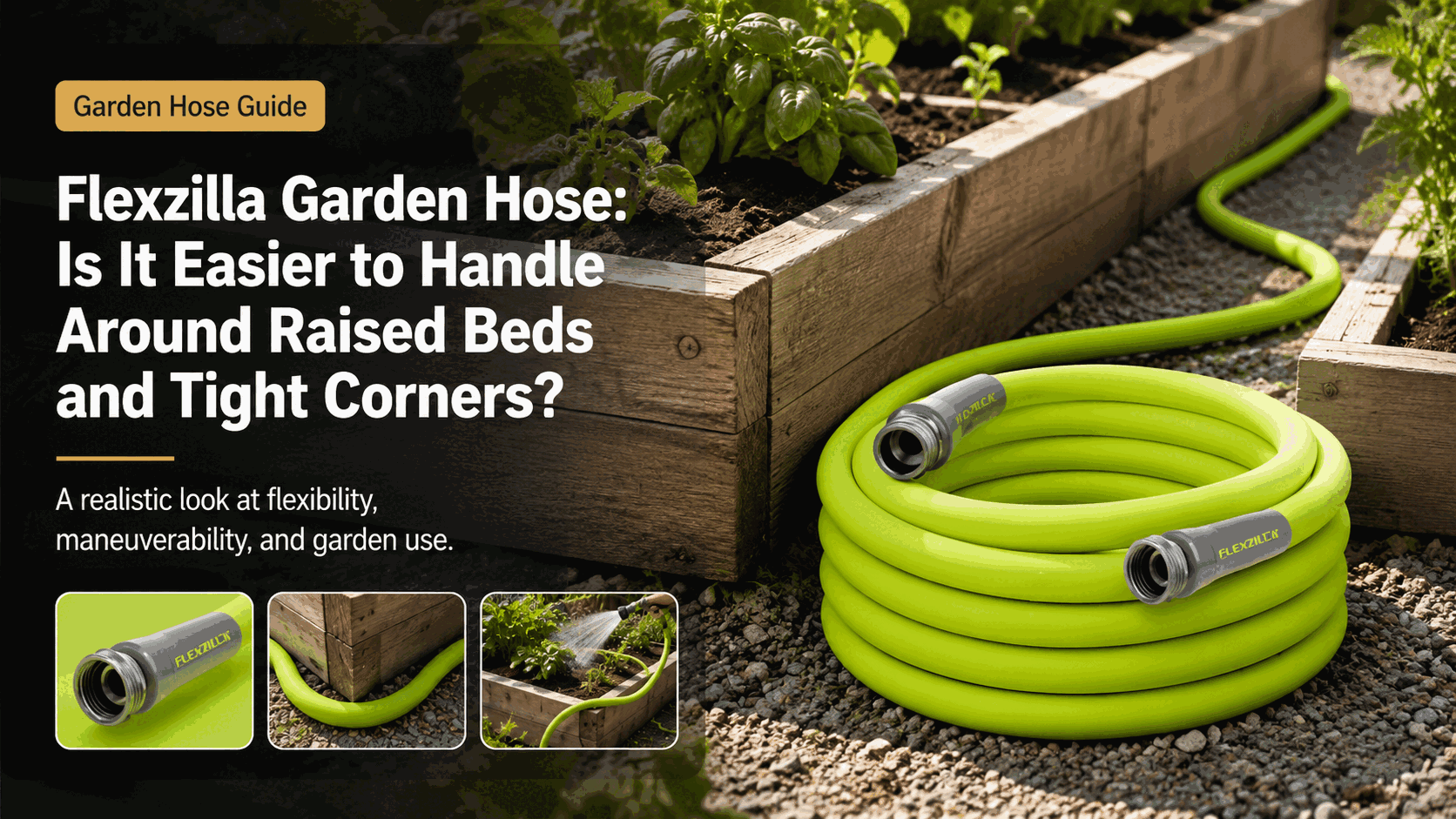
Flexzilla Garden Hose is worth judging by the job it needs to do in a real garden, not by a single headline specification. For raised-bed and side-yard gardeners who need a hose that can move through tight paths without constant fighting, twisting, or dragging, the useful buying questions are storage, handling, materials, routine fit, and the limits that appear once the product is used around soil, water, plants, paths, or outdoor storage.
This guide focuses on the supplied product information and practical garden use. The 5/8-inch by 50-foot HFZG550YW-E uses a flexible hybrid polymer, abrasion-resistant cover, anodized aircraft-aluminum fittings, a sealing O-ring, and a zero-memory design. Those features target maneuverability and flatter laying, which can be useful around raised beds, but any hose can kink when sharply folded, trapped under weight, or pulled around a tight object with water flow restricted. The goal is a realistic decision based on the work, not a marketing promise.
How to Evaluate Flexzilla Garden Hose
The first step is to translate specifications into the work you actually do. A home gardener may use the same item very differently from a nursery, landscape crew, or large-property owner. Start with the product’s physical format, then consider the surface, plant size, storage, frequency of use, and whether the job is repeated enough for convenience to matter.
The supplied product record highlights these practical details: 5/8-inch diameter and 50-foot length; flexible hybrid-polymer construction; abrasion-resistant outer cover; anodized aircraft-aluminum fittings and O-ring; zero-memory design intended to lie flatter; nozzle not included. None of these details should be considered in isolation. Capacity can be less useful when access is tight, lightweight construction can be less important when the task needs leverage, and a rich growing medium can be the wrong choice for a plant that needs leaner or faster-draining conditions.
For raised-bed and side-yard gardeners who need a hose that can move through tight paths without constant fighting, twisting, or dragging, the best test is a normal working day. Imagine where the product starts, how it reaches the task, what must be carried or measured, where it will be cleaned, and where it will sit afterward. That sequence reveals whether the convenience is real.
Five Buying Checks That Matter
Storage and Space
When you compare flexible hose for raised beds, Raised beds create repeated corners, so the hose should bend around edges without scraping plant stems or pulling lightweight irrigation fittings sideways. This matters because a product that performs well only in ideal conditions can still create more work when storage, access, cleaning, or setup is ignored.
Handling and Control
When you compare kink resistance around corners, Kink resistance improves convenience, but route the hose in wider arcs and remove sharp twists before turning the water fully on. This matters because a product that performs well only in ideal conditions can still create more work when storage, access, cleaning, or setup is ignored.
Task Match
When you compare lightweight hose handling, Lower handling weight matters most when you repeatedly reposition the hose between beds, carry it to storage, or work on a slope. This matters because a product that performs well only in ideal conditions can still create more work when storage, access, cleaning, or setup is ignored.
Routine Efficiency
When you compare garden hose maneuverability, Maneuverability depends on flexibility, surface drag, connection angle, length, and whether the hose tries to recoil while you move. This matters because a product that performs well only in ideal conditions can still create more work when storage, access, cleaning, or setup is ignored.
Long-Term Practicality
When you compare hose for narrow side yards, In narrow passages, measure the distance from spigot to the farthest bed and avoid buying much more hose than the route needs, because surplus length also needs somewhere to lie. This matters because a product that performs well only in ideal conditions can still create more work when storage, access, cleaning, or setup is ignored.
Where It Fits Best
A side-by-side task check is more useful than a generic “best for everyone” verdict. Use the table below to identify the situation closest to your own garden and then verify the product instructions before use.
| Situation | Practical Fit | What to Watch |
|---|---|---|
| Raised-bed corners | Good use case | Use broad bends instead of sharp folds |
| Narrow side yard | Manageable if length fits | Excess hose creates clutter |
| Long lawn reach | 50 ft may be enough | Measure route, not straight-line distance |
| Storage reel | Check reel compatibility | Drain before coiling |
| Sprinkler connection | Zero memory can help lie flat | No nozzle included with this listing |
The table is intentionally conservative. The most reliable decision comes from matching the product to normal work rather than chasing the maximum capacity, strongest claim, longest reach, or richest formula.
A Better Real-World Routine
Connect by hand without cross-threading, uncoil enough hose before pressurizing, route it outside delicate stems, and pull from a section that can move freely rather than from the fitting. After watering, shut off the spigot, release pressure, drain the hose, and coil it in large loops.
Before Each Use
- Check the product and working area for obvious damage or obstacles
- Confirm the task is within the listed size, capacity, or application limits
- Set up the route, container, plant, or work surface before starting
- Use controlled movements or measured amounts instead of forcing the task
- Pause when conditions change rather than continuing automatically
- Clean, drain, dry, or store the item according to its material and instructions
A repeatable routine makes comparison easier. Saving steps, improving control, or keeping a messy task organized without creating another problem are more meaningful advantages than a long list of secondary features.
Care, Storage, and Practical Limits
Check the O-ring when drips appear at the coupling, protect fittings from being driven over, and avoid storing the hose under continuous pressure. Drain before freezing weather and keep sharp tools away from the outer cover.
For broader technique and manufacturer context, review Flexzilla hose specifications. The manufacturer page is the appropriate source for current material, fitting, flexibility, and product-use specifications. Always give the current product label or manufacturer instructions priority for rates, loads, assembly, cleaning, storage, and safety.
Who Should Choose It
Flexzilla suits gardeners who prioritize flexibility, lighter handling, and repeated movement around beds. A compact expandable hose may store smaller, while a heavier commercial hose can be more appropriate when abrasion, vehicle traffic, or very long runs dominate the job.
A good purchase should reduce friction in the garden routine. If another product type solves the task with fewer compromises, choose that alternative instead of paying for features you will not use.
Final Buying Takeaway
Flexzilla Garden Hose should be selected for task fit first and specifications second. The useful features are the ones that support the way you already garden without creating new storage, handling, maintenance, or application problems.
Treat the first few uses as a verification period: pay attention to control, cleanup, storage, comfort, and whether the result is consistent.
Frequently Asked Questions
Does Flexzilla never kink?
No hose is immune to every kink. The design is intended to resist kinking, but sharp folds and trapped sections can still restrict flow.
Is a 50-foot hose enough for raised beds?
Measure the actual route from the spigot around corners to the farthest watering point and add reasonable working slack.
Does this listing include a nozzle?
The supplied product record states that a spray nozzle is not included.
Why does the connection drip?
Check the O-ring, thread alignment, hand tightness, and fitting condition before assuming the hose body is leaking.
Should the hose stay pressurized between uses?
It is better practice to shut off the supply and release pressure after watering, following the manufacturer instructions.
