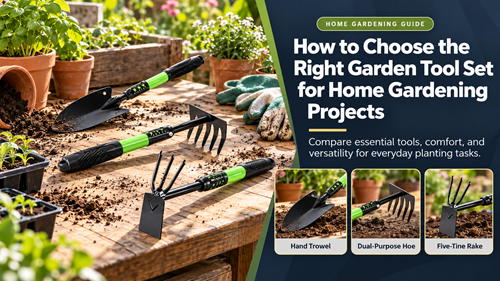
The right set is not the one with the highest piece count. A useful home kit combines a few dependable tools whose sizes, handle shapes, materials, and storage method fit the work you actually do. The focus of this guide is garden tool set selection for home gardeners who want useful equipment without unnecessary duplicates.
Good tools should fit the user, the property, and the job. Weight, handle shape, material, storage, maintenance, and the amount of work completed in one session all affect whether a tool remains practical after the first few uses.
How to Evaluate Garden Tool Set
Start with the jobs that repeat most often. A tool used every week deserves more attention to grip, balance, construction, and replacement parts than a specialty tool used once a year.
Measure the working area before buying. Raised beds, narrow side yards, containers, established borders, and open lawns all favor different tool lengths and head sizes. Storage space should also be measured rather than estimated.
Use manufacturer limits and instructions as boundaries. A tool that technically fits the task can still be the wrong choice if it requires excessive force, awkward posture, or repeated overloading.
Compare the Set Piece by Piece
Task Coverage
When comparing gardening kits, look at how the tool fits the specific job instead of judging it by appearance or piece count alone. Check working size, hand position, and whether the design reduces unnecessary movement.
Also consider cleanup and storage after the task. Dirt trapped around joints, damp storage, or forcing a tool into work it was not designed for can shorten service life even when the original construction is strong.
Comfort and Control
When comparing digging tools, look at how the tool fits the specific job instead of judging it by appearance or piece count alone. Check working size, hand position, and whether the design reduces unnecessary movement.
Also consider cleanup and storage after the task. Dirt trapped around joints, damp storage, or forcing a tool into work it was not designed for can shorten service life even when the original construction is strong.
Material and Build
When comparing pruning tools, look at how the tool fits the specific job instead of judging it by appearance or piece count alone. Check working size, hand position, and whether the design reduces unnecessary movement.
Also consider cleanup and storage after the task. Dirt trapped around joints, damp storage, or forcing a tool into work it was not designed for can shorten service life even when the original construction is strong.
Storage and Access
When comparing gardening accessories, look at how the tool fits the specific job instead of judging it by appearance or piece count alone. Check working size, hand position, and whether the design reduces unnecessary movement.
Also consider cleanup and storage after the task. Dirt trapped around joints, damp storage, or forcing a tool into work it was not designed for can shorten service life even when the original construction is strong.
Efficiency in Routine
When comparing outdoor tools, look at how the tool fits the specific job instead of judging it by appearance or piece count alone. Check working size, hand position, and whether the design reduces unnecessary movement.
Also consider cleanup and storage after the task. Dirt trapped around joints, damp storage, or forcing a tool into work it was not designed for can shorten service life even when the original construction is strong.
Long-Term Use
When comparing garden supplies, look at how the tool fits the specific job instead of judging it by appearance or piece count alone. Check working size, hand position, and whether the design reduces unnecessary movement.
Also consider cleanup and storage after the task. Dirt trapped around joints, damp storage, or forcing a tool into work it was not designed for can shorten service life even when the original construction is strong.
Quick Comparison
A side-by-side table helps separate necessary features from marketing extras.
| Garden Job | Useful Tool Type | What to Check |
|---|---|---|
| Raised beds | Trowel, cultivator, pruner | Compact tools and comfortable grip |
| Containers | Trowel, scoop, hand fork | Precision and easy cleanup |
| Shrubs | Pruner plus gloves | Blade quality and hand protection |
| New beds | Shovel plus fork | Strength and leverage |
| General upkeep | Weeder and pruner | Comfort over repeated use |
| Storage | Tote, rack, or case | Dry organized storage |
Build a Better Working Routine
Before buying, list the projects planned for the next six months. A set that covers most of those jobs with durable core tools will usually outperform a larger bundle filled with rarely used accessories.
Work through one test session before relying on the tool for a larger project. Notice hand fatigue, reach, control, blade or tine movement, and how easily the tool moves from use to cleanup.
Real-World Tool Check
- Confirm the task and work area
- Check handle length and grip size
- Inspect joints, blades, or tines
- Use moderate force first
- Watch for flex or slipping
- Clean the tool after testing
- Dry it before storage
- Record any recurring limitation
Care and Storage
Remove visible soil, sap, grass, and moisture before storage. Cutting tools benefit from sharp clean edges, while metal digging tools should be kept dry and checked for corrosion. Wooden handles should be inspected for splinters and looseness.
For science-based maintenance advice, review the Penn State Extension advice on choosing the right garden tool. Follow the tool manufacturer instructions when cleaning, sharpening, lubricating, or replacing parts.
Who This Setup Fits
This setup is most useful for home gardeners who want dependable tools for recurring yard, bed, container, and planting work without collecting equipment that duplicates the same function.
Gardeners with limited grip strength, reduced mobility, or tight storage should give extra weight to tool weight, leverage, handle geometry, and storage footprint rather than assuming a heavy professional-style tool is automatically better.
Choose Garden Tool Set for Real Garden Work
Garden tool set are most useful when the selection is based on real tasks, comfortable handling, durable construction, and a maintenance routine that keeps the equipment ready to work.
Start with the core jobs, test the tool under normal conditions, and add specialty equipment only when a recurring need appears. That approach usually creates a smaller, better garden setup.
Frequently Asked Questions
How many garden tool set does a beginner really need?
Start with the smallest group that covers recurring tasks. Add specialty tools only after a repeated need becomes clear.
What makes garden tool set comfortable to use?
Good fit depends on grip size, tool weight, handle length, balance, and the amount of force required for the job.
Are expensive garden tool set always better?
No. Construction quality and suitability matter more than price alone. Compare materials, joints, replaceable parts, and warranty support.
How should garden tools be stored?
Clean and dry tools before storing them in a dry organized location where edges and moving parts are protected.
When should a garden tool be replaced?
Replace or repair tools with unsafe cracks, loose heads, damaged locks, badly bent parts, or wear that prevents controlled use.
