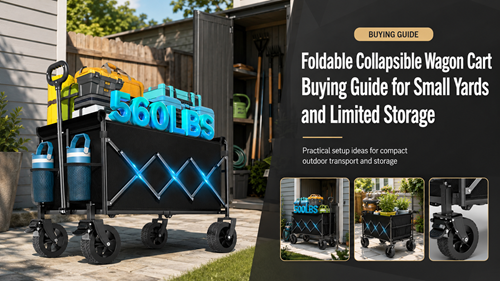
A foldable collapsible wagon cart is most valuable in a small yard when it disappears neatly after the work is done. In compact properties, the buying decision should focus on folded thickness, turning room, wheel behavior, and how quickly the wagon can be opened without rearranging a shed or patio.
Large-capacity carts can look attractive online, but extra frame length and wide wheels can be inconvenient around gates, raised beds, narrow side yards, and apartment storage closets. The best model is the one that supports routine transport while fitting the property every day.
How to Evaluate a Foldable Collapsible Wagon Cart
Start with the folded package. Record the maximum height, width, and depth available in the shed, trunk, balcony cabinet, or utility closet. Remember that wheels and handles can protrude beyond the fabric body.
Next, walk the hauling route. A wagon may technically fit a path but still need excessive back-and-forth movement at a corner. Measure gates and note steps, thresholds, slopes, gravel, and soft lawn areas.
Finally, compare the load. Small-yard gardeners often move potting mix, hand tools, watering equipment, compost, and a few planters rather than hundreds of pounds at once. A compact cart that makes more easy trips can outperform an oversized wagon that is difficult to deploy.
Small-Space Features Worth Comparing
Prioritize a Small Yard Footprint
A small yard folding wagon should clear gates and planting beds without forcing the user to lift one side around corners.
Check the handle angle and front-wheel swivel because the usable turning circle can be wider than the cart body.
Compare Compact Utility Designs
A compact collapsible utility cart is useful when the same cart must move garden supplies, groceries, or patio items and then store in a small footprint.
Avoid paying for oversized side extensions unless your routine includes long tools or bulky nursery trays.
Plan for Vertical Storage
A space saving garden wagon can save floor area when it stands securely on its folded base and the wheels do not roll or tip.
If vertical storage is not supported, use a wall or floor location that will not stress the folding joints.
Choose Wheels for the Real Route
Use folding wagon wheel selection to compare wheel diameter, width, tread, swivel design, and how easily debris can be cleaned from the axle area.
Small hard wheels are compact on pavement, while wider wheels may be easier on grass or gravel but increase folded bulk.
Fit the Cart to Tight Storage
A yard cart for tight storage should fold in seconds without loose pins or accessories that are easy to misplace.
Measure with any storage cover installed, because fabric covers and wheel position can add a few important inches.
Keep Garden Supplies Organized
A portable cart for garden supplies works better when small tools, gloves, and plant labels stay in bins rather than rolling under heavy bags.
Organization also makes unloading faster and reduces the chance of leaving sharp tools inside the fabric bed.
Small-Yard Wagon Trade-Offs
Compare storage and maneuverability before choosing by capacity alone.
| Feature | Compact Advantage | Possible Trade-Off |
|---|---|---|
| Narrow body | Fits gates and side yards | Less cargo width |
| Thin fold | Uses less closet or shed space | Smaller wheels may be used |
| Large wheels | Better on lawn and gravel | Adds folded bulk |
| Long bed | Fits trays and tools | Wider turning circle |
| Light frame | Easier to lift into trunk | May have lower rating |
| Brake wheels | Helps parking on slopes | Adds hardware and maintenance |
Run a Storage and Maneuverability Test
Mark the cart dimensions on the floor with tape before buying. This simple check shows whether a larger wagon will block a door, collide with shelves, or make a narrow storage area frustrating.
After purchase, load a typical bag, hand-tool bin, and planter. Pull the wagon through the narrowest route at walking speed and note how often you need to lift, reverse, or reposition it.
Compact Property Test
- Measure the smallest gate
- Measure the storage opening
- Check folded wheel position
- Test one-hand unfolding
- Load everyday supplies
- Turn around a raised bed
- Park on the usual surface
- Fold and store while empty
A small-space cart should reduce setup time. If deploying it requires moving several other items first, a smaller or differently folding model may be a better choice.
Storage Habits That Extend Cart Life
Remove wet soil and leaves before folding. Dry the fabric and wheel area, then store the wagon where sharp tools, fertilizers, and direct weather will not damage the liner or frame.
Inspect the handle lock and folding joints because compact carts are opened and closed frequently. Tight, clean joints help the wagon fold without sudden movement.
For a manufacturer example of inspection, load distribution, tire limits, and safe cart use, consult the Gorilla Carts safety manual.
Best Fit for Apartments, Townhouses, and Small Yards
This format is a strong fit when storage space is limited but the garden still requires regular trips with soil, pots, tools, or harvested produce. It is also practical for gardeners who must lift the empty cart into a vehicle.
A rigid cart may be a better choice when storage is not constrained and loads are consistently abrasive or very heavy. Compact folding designs are strongest when convenience and storage efficiency matter as much as capacity.
Choose a Foldable Collapsible Wagon Cart That Stores Easily
A foldable collapsible wagon cart should fit the property twice: once while rolling through the yard and again while folded in storage. Measure both situations before comparing maximum load numbers.
The right cart opens quickly, turns without repeated lifting, carries normal supplies comfortably, and stores without blocking the space around it.
Frequently Asked Questions
How small should a folded wagon be for apartment storage?
Use the actual closet, balcony cabinet, or trunk measurements and leave room to lift or roll the cart in and out.
Are large wheels bad for small yards?
Not necessarily. They can improve travel on grass, but they add width and folded bulk, so measure first.
Should a folding wagon stand upright when stored?
Only if the design supports stable vertical storage. Do not lean it where it can roll or fall.
Can a compact wagon carry potting soil?
Yes when the combined load stays within the manufacturer rating and the bags fit flat in the bed.
What is the most important small-yard feature?
A practical balance of turning radius, folded size, and enough capacity for normal garden trips.
