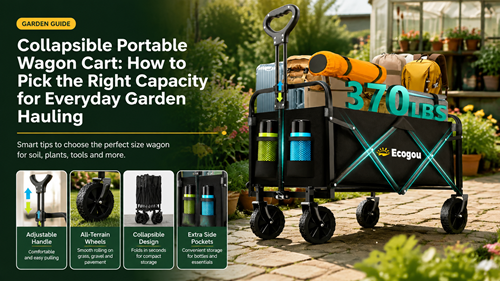
A collapsible portable wagon cart can remove a surprising amount of repeated lifting from everyday garden work, but the biggest model is not automatically the most useful one. Capacity has to match the real loads you move, the width of your paths, the way the wagon turns, and the storage space available after the job is finished.
For home gardeners, the practical question is not simply how many pounds a cart can carry. Soil bags, mulch, planters, hand tools, harvest baskets, and pruning debris all occupy space differently, so both volume and weight should be considered before buying.
How to Size a Collapsible Portable Wagon Cart
Start by writing down the three loads you move most often. A pair of large soil bags may be heavy but compact, while empty nursery pots and branches may be light yet bulky. A useful wagon needs enough bed volume for both situations without becoming awkward in narrow paths.
Published weight limits usually assume a stable, evenly distributed load. Sharp turns, slopes, soft soil, curbs, and concentrated weight can make a cart feel difficult well before the printed maximum is reached. Treat the rating as an upper boundary, not a target for every trip.
The folded dimensions matter just as much. Measure the shelf, shed corner, garage wall, or trunk where the cart will live. A model that saves walking during use but blocks a doorway between jobs is not an efficient choice.
Six Capacity Checks Before You Buy
Match Capacity to Bagged Materials
Use a portable garden wagon capacity guide to compare bed size with the number of soil or mulch bags you normally move. Check whether the sides support bulky bags without forcing them above the frame.
A modest margin is useful because bags shift during turns. Keep the heaviest items low and centered instead of stacking them high against one side.
Plan for Soil and Compost Bags
A wagon cart for soil bags should have a stable floor, adequate frame support, and wheels that do not sink badly on your usual surface.
Count the real bag weights used in your garden. Two dense bags can approach a practical limit faster than a cart full of lightweight hand tools.
Move Planters Without Crowding
When choosing a folding cart for moving planters, measure the planter base rather than the foliage. Containers should sit flat and should not rely on stems or leaves for support.
For tall pots, a longer bed can be more useful than a higher weight rating. Use padding or spacing when ceramic containers can knock together.
Interpret the Published Limit
Treat garden wagon load limit tips as a reminder to compare static capacity, moving capacity, and the manufacturer instructions rather than assuming every number means the same thing.
The safe working load may be lower on slopes or soft ground. Never transport people unless the product is specifically designed and rated for passengers.
Choose a Compact Hauling Footprint
A compact yard hauling trolley is easier to thread between raised beds, gates, parked vehicles, and patio furniture when exterior width stays manageable.
Turn the handle through its full range when comparing models. The turning circle can matter more than bed length in a tight yard.
Measure the Folded Package
Use collapsible cart storage ideas to compare folded thickness, wheel position, carry handles, and whether the cart stands upright when stored.
A storage cover can keep fabric and wheels cleaner, but the wagon should be dry before it is folded for a long period.
Capacity and Storage Trade-Offs
A side-by-side check prevents a high capacity number from hiding a poor fit for the property.
| Need | What to Measure | Why It Matters |
|---|---|---|
| Soil bags | Total weight and bag footprint | Dense loads use weight capacity quickly |
| Planters | Base diameter and bed length | Prevents tipping and crowding |
| Mulch or debris | Bed volume and side height | Light loads can be bulky |
| Narrow paths | Overall width and turning circle | Controls maneuverability |
| Car transport | Folded height and thickness | Confirms trunk or cargo fit |
| Frequent use | Empty cart weight | Affects setup and lifting |
Test the Wagon With Your Real Garden Loads
Before relying on the cart for a major project, run several ordinary trips with the kinds of items you actually move. Start below the maximum and note steering effort, wheel sink, handle flex, and whether the load shifts.
Repeat the test on the hardest section of the route, such as a gravel turn, lawn edge, threshold, or gentle slope. The route often reveals more than the specification table.
Real-World Capacity Test
- Measure the bed and folded dimensions
- Weigh or estimate a normal load
- Load heavy items low and centered
- Check tire pressure when applicable
- Pull through the narrowest path
- Turn on the tightest corner
- Test the storage location
- Inspect frame and fabric afterward
If the wagon feels unstable at a normal load, choose a better wheel or frame design rather than planning to operate near the printed maximum.
Care, Storage, and Load Safety
Brush out soil and plant debris after use, allow wet fabric to dry, and inspect wheel fasteners, frame joints, and handle locks periodically. Grit in folding joints can make a cart harder to close and can accelerate wear.
Do not use a garden wagon for passengers unless the manufacturer explicitly allows it. Distribute heavy materials across the floor and keep sharp tools covered so they do not damage the liner.
For a manufacturer example of how cart ratings, tire limits, even load distribution, and pre-use inspection are treated in safety instructions, review the Gorilla Carts owner manual.
Who Benefits Most From This Capacity Range
This type of wagon works best for gardeners who make repeated medium-load trips between a garage, driveway, raised beds, potting area, and compost pile. It can also help with nursery purchases when the bed is long enough for several containers.
Choose a rigid dump cart instead when the routine is dominated by loose rock, very heavy compost, sharp debris, or loads that need a tipping bed. A collapsible wagon earns its space when easy storage and mixed everyday loads matter most.
Choose Collapsible Portable Wagon Cart Capacity for the Routine
A collapsible portable wagon cart should be sized around your normal garden trips, not the largest load you can imagine. Bed dimensions, real working weight, wheel behavior, turning space, and folded storage all contribute to useful capacity.
Measure first, leave a safety margin, and test the route with a moderate load. A well-sized wagon saves steps without becoming another bulky item that is difficult to steer or store.
Frequently Asked Questions
How much capacity should a home garden wagon have?
Enough for the heaviest normal load with a sensible margin below the manufacturer maximum. Compare weight and volume together.
Can I load a wagon to its maximum rating on grass?
The printed rating does not guarantee easy handling on soft grass. Wheel sink and steering effort can reduce practical capacity.
Is a larger wagon always better for soil bags?
No. Large wagons can be harder to turn and store. A smaller cart may be faster if it handles two or three bags comfortably.
How should tall planters be carried?
Keep bases flat, use spacing or padding, and avoid allowing foliage to support the container.
Should a collapsible wagon be stored folded?
Yes when the manufacturer allows it, but clean and dry the fabric and joints first.
