
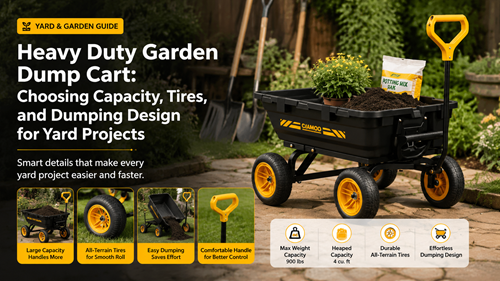
A heavy duty garden dump cart can move mulch, compost, soil, rock, firewood, and cleanup debris with less repeated carrying, but the useful capacity is determined by more than the largest number on the specification sheet. Tire design, bed volume, axle placement, frame strength, and the dumping mechanism all affect real yard performance.
Dense materials deserve special attention. A cart that holds a large volume of mulch may reach its weight limit quickly when filled with wet soil or stone. Choose the cart around the heaviest material you actually move, then verify that the dumping action remains controllable.
How to Size a Heavy Duty Garden Dump Cart
Start by separating weight capacity from bed volume. Mulch fills space quickly but is relatively light; wet soil, gravel, and rock can reach the weight limit while the bed is still partly empty.
Tires affect both rolling effort and stability. Large pneumatic tires can smooth rough ground but require pressure maintenance. Solid tires remove puncture concerns but may transmit more vibration.
Dump geometry matters when unloading near a bed or compost pile. The pivot should allow the material to clear the cart without forcing the user to lift the entire load manually.
Six Heavy-Hauling Features to Compare
Size the Cart for Mulch
A dump cart for mulch hauling should provide enough bed volume that light bulky material can be moved efficiently without piling above a safe visibility level.
Mulch loads often test volume before weight, so side height and bed shape matter.
Choose Tires for the Property
Use garden cart tire selection to compare tire diameter, pneumatic maintenance, traction, and how the cart behaves on lawn, gravel, and compacted soil.
Check pressure regularly when the design uses air-filled tires.
Interpret Yard Capacity Carefully
yard dump wagon capacity should be compared with the density of wet soil, compost, stone, and firewood rather than treated as a target for every load.
Keep heavy material evenly distributed over the bed and axle area.
Test the Tipping Mechanism
A utility cart tipping mechanism should release deliberately, stay latched while moving, and allow the bed to return without trapping fingers.
Practice the motion with a light load before using the cart near capacity.
Plan for Dense Materials
A cart for rocks and compost needs a durable bed and stable frame because small dense loads create concentrated forces.
Avoid dropping large rocks from height into a plastic bed unless the manufacturer allows that use.
Compare the Whole Hauling System
heavy yard hauling equipment should be chosen around route width, slope, surface, unloading area, and who will pull or tow the cart.
A lower-capacity cart that remains controllable can be more productive than a larger cart that is difficult to stop.
Dump Cart Choice by Material
Material density changes what practical capacity means.
| Material | Primary Limit | Useful Feature |
|---|---|---|
| Mulch | Bed volume | High sides and easy dump |
| Compost | Weight and moisture | Stable bed and washable surface |
| Wet soil | High density | Strong axle and moderate load |
| Rock | Very high density | Rigid bed and frame |
| Firewood | Irregular shape | Side containment |
| Garden debris | Bulk and sharp edges | Durable liner or bed |
Practice the Dump Before a Heavy Project
Choose a level open area and test the latch with a light load. Learn where the bed pivots and where the material lands before working near retaining walls, slopes, or delicate plants.
Increase the load gradually and stop when pulling, braking, or tipping requires excessive effort. The goal is repeatable control, not proving the maximum rating.
Heavy Cart Pre-Use Check
- Inspect tires and pressure
- Check axle and wheel fasteners
- Confirm dump latch is closed
- Center the load
- Keep hands clear of pivot points
- Walk the route before loading
- Dump on stable ground
- Inspect the bed after use
If the cart is towable, follow the manufacturer speed and hitch instructions. Do not assume a hand-pull rating applies identically when towing.
Maintain Tires, Latches, and the Bed
Rinse corrosive fertilizer or wet soil residue as appropriate, dry metal components, and clean the dump latch so grit does not prevent full engagement.
Inspect pneumatic tires for damage and maintain the specified pressure. Replace damaged hardware before the next heavy load rather than compensating with slower handling.
Gorilla Carts publishes detailed guidance on distributed loads, dumping limits, speed, tire pressure, and inspection in this official dump-cart manual.
Who Needs a Dump Cart Instead of a Folding Wagon
A dump cart is a strong choice for repeated loose-material work such as mulch, compost, soil, rock, and firewood. The rigid bed and tipping action save time at the unloading point.
A collapsible wagon is often easier for mixed household loads, nursery trays, and compact storage. Choose the dump cart when heavy material movement is the regular job.
Choose a Heavy Duty Garden Dump Cart for Controlled Loads
A heavy duty garden dump cart should make dense yard projects easier without encouraging unsafe overloads. Match capacity to material density, choose tires for the surface, and test the tipping mechanism under controlled conditions.
The best cart is the one that can be loaded, moved, stopped, and dumped repeatedly with predictable control.
Frequently Asked Questions
How much weight should I put in a dump cart?
Stay within the manufacturer rating and use a lower practical load when terrain, slope, or material density makes the cart hard to control.
Are pneumatic tires better for dump carts?
They often smooth rough ground but require pressure maintenance and can puncture. Solid tires need less maintenance.
Can a dump cart be filled completely with rocks?
Not necessarily. Rock is dense and may reach the weight limit long before the bed is full.
What should I check on the dump latch?
Confirm it locks fully before moving and releases deliberately without placing hands near pinch points.
Is a dump cart better than a wheelbarrow?
It can carry larger stable loads with less balancing, while wheelbarrows may maneuver better in very narrow areas.
