
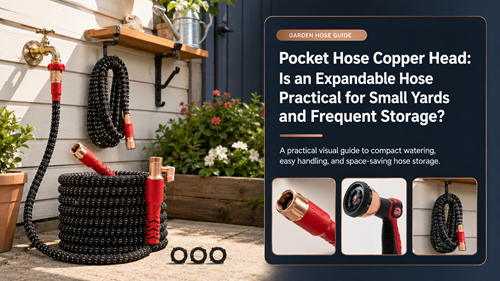
Pocket Hose Copper Head is worth judging by the job it needs to do in a real garden, not by a single headline specification. For small-yard homeowners who want a hose that shrinks after use and can be stored frequently without a large reel or bulky coil, the useful buying questions are storage, handling, materials, routine fit, and the limits that appear once the product is used around soil, water, plants, paths, or outdoor storage.
This guide focuses on the supplied product information and practical garden use. The product record describes a 50-foot expandable hose with a 360-degree Pocket Pivot, Tri-Tex tubing, Force Field outer jacket, APT-protected connections, lead-free construction claims, and a 10-pattern sprayer. The main convenience is compact storage after the water is shut off and the hose drains. Expandable designs still need careful connection, pressure management, drainage, and protection from abrasion to maintain service life. The goal is a realistic decision based on the work, not a marketing promise.
How to Evaluate Pocket Hose Copper Head
The first step is to translate specifications into the work you actually do. A home gardener may use the same item very differently from a nursery, landscape crew, or large-property owner. Start with the product’s physical format, then consider the surface, plant size, storage, frequency of use, and whether the job is repeated enough for convenience to matter.
The supplied product record highlights these practical details: 50-foot expanded reach; expands under water pressure and contracts after draining; 360-degree Pocket Pivot connection feature; Tri-Tex tubing and Force Field outer jacket; 10-pattern sprayer included in the supplied product record. None of these details should be considered in isolation. Capacity can be less useful when access is tight, lightweight construction can be less important when the task needs leverage, and a rich growing medium can be the wrong choice for a plant that needs leaner or faster-draining conditions.
For small-yard homeowners who want a hose that shrinks after use and can be stored frequently without a large reel or bulky coil, the best test is a normal working day. Imagine where the product starts, how it reaches the task, what must be carried or measured, where it will be cleaned, and where it will sit afterward. That sequence reveals whether the convenience is real.
Five Buying Checks That Matter
Storage and Space
When you compare expandable hose for small yards, Expandable hoses make the most sense when the required reach is moderate and compact storage matters more than leaving a hose permanently laid around the yard. This matters because a product that performs well only in ideal conditions can still create more work when storage, access, cleaning, or setup is ignored.
Handling and Control
When you compare compact hose storage solution, Compared with a conventional 50-foot hose, the contracted bundle can occupy less space, but it still needs a ventilated spot where it can finish draining. This matters because a product that performs well only in ideal conditions can still create more work when storage, access, cleaning, or setup is ignored.
Task Match
When you compare retracting garden hose convenience, The hose contracts as pressure is released and water drains; that is different from a spring-loaded retractable reel and still requires the user to gather and store it. This matters because a product that performs well only in ideal conditions can still create more work when storage, access, cleaning, or setup is ignored.
Routine Efficiency
When you compare hose fitting durability check, Inspect swivel points, washers, threads, strain-relief areas, and the first few inches of hose near each connection because repeated bending often concentrates there. This matters because a product that performs well only in ideal conditions can still create more work when storage, access, cleaning, or setup is ignored.
Long-Term Practicality
When you compare lightweight outdoor watering hose, Lower carrying bulk can help with frequent storage, but avoid dragging the hose across sharp masonry, thorny beds, or vehicle paths even when the outer jacket is reinforced. This matters because a product that performs well only in ideal conditions can still create more work when storage, access, cleaning, or setup is ignored.
Where It Fits Best
A side-by-side task check is more useful than a generic “best for everyone” verdict. Use the table below to identify the situation closest to your own garden and then verify the product instructions before use.
| Situation | Practical Fit | What to Watch |
|---|---|---|
| Small backyard | Strong use case | 50 ft should match route |
| Frequent storage | Main advantage | Drain fully before putting away |
| Permanent hose reel | Less necessary | Expandable hose contracts loose |
| Sharp gravel path | Use caution | Protect jacket from abrasion |
| High-demand sprinkler | Check flow and pressure needs | Expandable behavior depends on pressure |
The table is intentionally conservative. The most reliable decision comes from matching the product to normal work rather than chasing the maximum capacity, strongest claim, longest reach, or richest formula.
A Better Real-World Routine
Connect the hose with the water off, place it where expansion will not snag plants, turn the supply on gradually, and let it reach operating length before pulling hard on it. After use, shut off the spigot, release nozzle pressure, allow the hose to contract and drain, then store it out of direct traffic.
Before Each Use
- Check the product and working area for obvious damage or obstacles
- Confirm the task is within the listed size, capacity, or application limits
- Set up the route, container, plant, or work surface before starting
- Use controlled movements or measured amounts instead of forcing the task
- Pause when conditions change rather than continuing automatically
- Clean, drain, dry, or store the item according to its material and instructions
A repeatable routine makes comparison easier. Saving steps, improving control, or keeping a messy task organized without creating another problem are more meaningful advantages than a long list of secondary features.
Care, Storage, and Practical Limits
Inspect fittings and the jacket for cuts, keep the hose away from sharp edges and hot surfaces, and drain before freezing conditions. Do not leave it pressurized unattended or stored where tools can crush the contracted bundle.
For broader technique and manufacturer context, review Pocket Hose Copper Head specifications. The manufacturer’s Copper Head page is the appropriate source for current construction, connection, sprayer, and use specifications. Always give the current product label or manufacturer instructions priority for rates, loads, assembly, cleaning, storage, and safety.
Who Should Choose It
Pocket Hose Copper Head fits small properties where the hose is brought out for each watering session and compact storage is a priority. A conventional hybrid hose may be better when the hose stays deployed, experiences rough abrasion, or must supply equipment that benefits from more predictable hose geometry.
A good purchase should reduce friction in the garden routine. If another product type solves the task with fewer compromises, choose that alternative instead of paying for features you will not use.
Final Buying Takeaway
Pocket Hose Copper Head should be selected for task fit first and specifications second. The useful features are the ones that support the way you already garden without creating new storage, handling, maintenance, or application problems.
Treat the first few uses as a verification period: pay attention to control, cleanup, storage, comfort, and whether the result is consistent.
Frequently Asked Questions
Does the Pocket Hose retract onto a reel automatically?
No. It contracts as water pressure is released and the hose drains, but the user still gathers and stores it.
Is 50 feet enough for a small yard?
Measure the actual route from the spigot around beds, furniture, and corners rather than using straight-line distance.
Should an expandable hose stay pressurized after use?
No. Shut off the supply, release pressure, drain it, and store it according to the manufacturer instructions.
Can it be dragged across concrete?
Occasional contact may occur, but repeated abrasion on sharp masonry can shorten the life of any expandable jacket.
Does it include a nozzle?
The supplied product record states that a 10-pattern sprayer is included.
