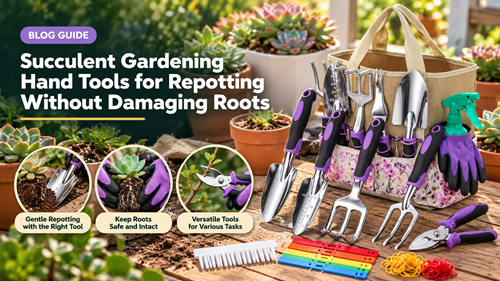

Succulent Gardening Hand Tools are useful because repotting often happens in small pots with fragile roots, gritty soil, and narrow spaces around leaves. Large trowels can spill soil or press against the plant, while fine tools make it easier to lift roots, place mix, remove debris, and work around compact rosettes.
The goal is not to collect the smallest possible tools. Each piece should solve a specific job without encouraging poking, pulling, or compacting the root ball. Good drainage and appropriate pot size remain more important than elaborate accessories.
How to Evaluate Succulent Gardening Hand Tools
Work on a tray or mat so spilled gritty mix can be controlled and reused only when appropriate. Small tools reduce mess when the workspace is limited.
Choose tools with smooth edges and clean tips. Rough metal, burrs, or sharp unfinished seams can damage roots and scratch containers.
Repot only when needed and prepare the new container and mix before removing the plant so roots spend less time exposed.
Succulent Gardening Hand Tools decisions are easiest to defend when the product is tested against the exact space, material, plant, or route described above rather than a generic maximum claim.
Six Buying Checks That Matter
Choose Tools for Repotting
When comparing succulent repotting tools, A repotting kit should help loosen soil, support the root ball, add fresh mix, and clean the finished plant without crowding the pot.
Select the smallest number of tools that accomplish those jobs comfortably rather than using every accessory in a kit.
Protect Root Access
When comparing tools for succulent roots, Narrow tools can reach around a root ball with less disruption than a broad shovel. Use gentle movements and stop when resistance suggests a thick root or hard object.
Do not comb healthy roots aggressively simply because a rake is included; only remove damaged material when appropriate for the plant.
Use Small Tools Carefully
When comparing small succulent tools, Small scoops and trowels make it easier to direct gritty mix into gaps without burying the crown.
Very short handles can reduce leverage, so use them for precision rather than forcing hard compacted soil.
Build a Simple Kit
When comparing succulent planting kit, A useful planting kit may include a narrow trowel, scoop, tweezers, brush, and small cultivator.
Keep cutting tools separate unless propagation or root trimming is part of the planned work.
Work with Mini Tools
When comparing mini garden tools, Mini tools are helpful for tabletop containers and shallow arrangements where full-size hand tools block visibility.
Check handle comfort before a long repotting session because small grips can require more finger pressure.
Support Ongoing Care
When comparing succulent care tools, Tools should support proper potting mix and drainage rather than compensate for soil that stays wet too long.
After repotting, remove soil from leaves and tools and allow the plant care routine to follow its normal light and watering needs.
Where It Fits Best
A side-by-side task check is more useful than a generic “best for everyone” verdict. Use the table below to match the product to normal work and then verify the current product instructions before use.
| Situation | Practical Fit | What to Watch |
|---|---|---|
| Narrow trowel | Moving soil | Blade edge |
| Scoop | Adding gritty mix | Controlled pour |
| Tweezers | Debris removal | Tip smoothness |
| Mini cultivator | Surface loosening | Root pressure |
| Brush or blower | Leaf cleanup | Gentle airflow |
| Tray or mat | Mess control | Easy cleaning |
The table is intentionally conservative. The most reliable decision comes from matching the product to normal work rather than chasing the maximum capacity, longest reach, highest piece count, or strongest claim.
A Better Real-World Routine
Set up the work area before the first full task. Confirm the route, container, plant, soil condition, or material involved and use a light test first so fit and control can be checked without committing to the hardest job.
Keep a simple record of what worked: tool size, load, application amount, storage position, or setup. Repeatable decisions make future purchases and maintenance easier.
Before Each Use
- Prepare pot and mix first
- Choose tool size by pot
- Inspect metal for burrs
- Support the root ball
- Avoid pulling healthy roots
- Add mix gradually
- Clean soil from leaves
- Wash and dry tools
A repeatable routine makes comparison easier. Saving steps, improving control, or keeping a messy task organized without creating another problem are more meaningful advantages than a long list of secondary features.
Care, Storage, and Practical Limits
Clean gritty particles from tool joints and tweezers, dry metal surfaces, and store small sharp tools where tips will not bend or injure hands.
For broader technique and safety context, review University of Minnesota Extension guidance on succulent potting mix, drainage, and care. Always give the current product label, manual, or manufacturer instructions priority for rates, loads, assembly, cleaning, storage, and replacement parts.
Who Should Choose It
This setup fits succulent and cactus growers working in small containers, indoor arrangements, and tabletop repotting spaces where precision matters more than heavy digging power.
A good purchase should reduce friction in the garden routine. If another product type solves the task with fewer compromises, choose that alternative instead of paying for features you will not use.
Final Buying Takeaway
Succulent Gardening Hand Tools should make repotting more controlled, not more complicated. Choose smooth narrow tools that fit the pot, prepare the container first, and use gentle movements around roots.
Succulent Gardening Hand Tools should be treated as a practical tool or product choice: verify current specifications, use the first few sessions as a test period, and keep the setup that remains controlled, easy to maintain, and consistent.
Frequently Asked Questions
Do succulents need special repotting tools?
Not always, but narrow tools make small pots and gritty soil easier to manage.
Should I loosen every succulent root ball?
No. Handle roots gently and remove only damaged or problematic material as appropriate.
What tool helps add soil around a rosette?
A narrow scoop or small trowel gives better placement without covering the crown.
Are tweezers useful?
They can remove debris and place material in tight areas, provided the tips are smooth.
What matters more than the tools?
Good drainage, suitable potting mix, appropriate pot size, and correct watering remain more important.
