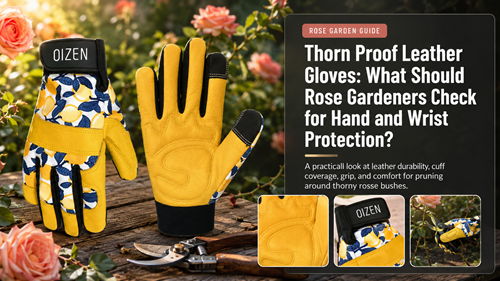
Thorn Proof Leather Gloves is worth judging by the job it needs to do in a real garden, not by a single headline specification. For rose, blackberry, and bramble gardeners who want more protection without losing too much control of pruning tools, the useful buying questions are storage, handling, materials, routine fit, and the limits that appear once the product is used around soil, water, plants, paths, or outdoor storage.
This guide focuses on the supplied product information and practical garden use. These gloves use grain cowhide at the palm, padded and reinforced contact areas, stretch fabric across the back, an adjustable wrist closure, and touchscreen-capable fingertips. That combination can improve routine thorn and abrasion protection, but “thorn proof” should not be read as a literal guarantee against every rigid thorn, splinter, wire, or puncture. Fit and wrist coverage matter as much as leather thickness. The goal is a realistic decision based on the work, not a marketing promise.
How to Evaluate Thorn Proof Leather Gloves
The first step is to translate specifications into the work you actually do. A home gardener may use the same item very differently from a nursery, landscape crew, or large-property owner. Start with the product’s physical format, then consider the surface, plant size, storage, frequency of use, and whether the job is repeated enough for convenience to matter.
The supplied product record highlights these practical details: grain cowhide palm construction; padded palm and reinforced fingertips; breathable stretch material on the back of the hand; hook-and-loop wrist adjustment; touchscreen-compatible fingertips. None of these details should be considered in isolation. Capacity can be less useful when access is tight, lightweight construction can be less important when the task needs leverage, and a rich growing medium can be the wrong choice for a plant that needs leaner or faster-draining conditions.
For rose, blackberry, and bramble gardeners who want more protection without losing too much control of pruning tools, the best test is a normal working day. Imagine where the product starts, how it reaches the task, what must be carried or measured, where it will be cleaned, and where it will sit afterward. That sequence reveals whether the convenience is real.
Five Buying Checks That Matter
Storage and Space
When you compare rose pruning hand protection, Rose work combines sharp thorns with shears, so protection should cover the palm and fingers while still allowing a secure grip on the tool handles. This matters because a product that performs well only in ideal conditions can still create more work when storage, access, cleaning, or setup is ignored.
Handling and Control
When you compare leather gloves for thorn bushes, Leather resists many scratches better than thin knit fabric, but inspect seams and flex points because a thorn can still find a gap or worn area. This matters because a product that performs well only in ideal conditions can still create more work when storage, access, cleaning, or setup is ignored.
Task Match
When you compare puncture resistant garden gloves, Puncture resistance is a relative performance feature, not an invitation to squeeze stems or test sharp points through the glove. This matters because a product that performs well only in ideal conditions can still create more work when storage, access, cleaning, or setup is ignored.
Routine Efficiency
When you compare wrist coverage for brambles, Blackberry and climbing rose canes often contact the wrist and lower forearm, so compare cuff length with the plants you actually prune. This matters because a product that performs well only in ideal conditions can still create more work when storage, access, cleaning, or setup is ignored.
Long-Term Practicality
When you compare gloves for blackberry pruning, Choose a snug enough fit to control pruners, then position canes with the non-cutting hand away from the blade path instead of relying on the glove as cut protection. This matters because a product that performs well only in ideal conditions can still create more work when storage, access, cleaning, or setup is ignored.
Where It Fits Best
A side-by-side task check is more useful than a generic “best for everyone” verdict. Use the table below to identify the situation closest to your own garden and then verify the product instructions before use.
| Situation | Practical Fit | What to Watch |
|---|---|---|
| Rose deadheading | Good fit | Need dexterity and thorn protection |
| Blackberry canes | Good with adequate cuff | Forearm exposure may remain |
| Fine transplanting | May feel bulky | Use a lighter glove if no thorns |
| Wet muddy work | Leather needs drying | Do not store saturated |
| Power-tool work | Not automatically rated | Use task-specific PPE |
The table is intentionally conservative. The most reliable decision comes from matching the product to normal work rather than chasing the maximum capacity, strongest claim, longest reach, or richest formula.
A Better Real-World Routine
Try the gloves with the exact pruners you use. Flex the fingers, open and close the shear, and make sure the cuff does not catch on the handle. During pruning, hold stems away from your body and set cut pieces down instead of tucking thorny canes under an arm.
Before Each Use
- Check the product and working area for obvious damage or obstacles
- Confirm the task is within the listed size, capacity, or application limits
- Set up the route, container, plant, or work surface before starting
- Use controlled movements or measured amounts instead of forcing the task
- Pause when conditions change rather than continuing automatically
- Clean, drain, dry, or store the item according to its material and instructions
A repeatable routine makes comparison easier. Saving steps, improving control, or keeping a messy task organized without creating another problem are more meaningful advantages than a long list of secondary features.
Care, Storage, and Practical Limits
Brush soil off after use, let leather dry naturally away from direct heat, and inspect fingertips and seams before the next thorn-heavy job. Replace gloves when the leather becomes thin, split, stiff, or punctured.
For broader technique and manufacturer context, review gardening safety and tool choice. Penn State Extension’s ergonomic guidance supports matching protective gear and tools to the task instead of compensating for awkward grip or body position. Always give the current product label or manufacturer instructions priority for rates, loads, assembly, cleaning, storage, and safety.
Who Should Choose It
These gloves suit routine roses, brambles, thorny ornamentals, and cleanup where palm protection and tool control are both important. Choose longer gauntlet gloves when forearm exposure is the main hazard, and task-rated cut protection when sharp blades or powered equipment are involved.
A good purchase should reduce friction in the garden routine. If another product type solves the task with fewer compromises, choose that alternative instead of paying for features you will not use.
Final Buying Takeaway
Thorn Proof Leather Gloves should be selected for task fit first and specifications second. The useful features are the ones that support the way you already garden without creating new storage, handling, maintenance, or application problems.
Treat the first few uses as a verification period: pay attention to control, cleanup, storage, comfort, and whether the result is consistent.
Frequently Asked Questions
Are thorn proof gloves completely puncture proof?
No. Leather and reinforcement can reduce risk, but no ordinary garden glove should be treated as immune to every thorn or sharp object.
Do rose gloves need long cuffs?
Longer cuffs help when canes frequently contact the wrist or forearm, but the required length depends on the plant and pruning style.
Can leather gloves be washed in a machine?
Follow the manufacturer care instructions. Repeated soaking and heat can damage or stiffen leather.
Are these gloves suitable for pruning shears?
They can be, if the fit allows a secure grip and normal trigger or handle movement. Gloves do not replace safe blade handling.
When should thorn gloves be replaced?
Replace them when seams open, fingertips thin out, punctures appear, or the leather becomes too stiff for safe tool control.
