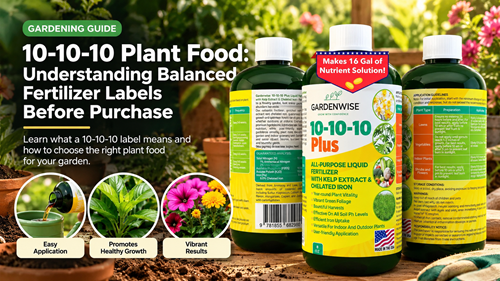

10-10-10 Plant Food is called balanced because the label lists equal percentages of nitrogen, phosphate, and potash. Equal numbers do not mean every lawn, vegetable bed, flower border, or container needs those nutrients in equal amounts. The correct fertilizer starts with the plant and soil rather than the symmetry of the label.
Before purchasing, read the guaranteed analysis, product form, recommended crops, application rate, timing, and any local restrictions. A soil test can show whether phosphorus or potassium is already sufficient, helping prevent unnecessary application.
How to Evaluate 10-10-10 Plant Food
The three numbers are percentages by weight for nitrogen, phosphate, and potash. A 10-pound bag therefore contains different nutrient amounts than a larger bag even though the ratio is the same.
Balanced does not mean gentle. Application rate determines how much nutrient reaches the soil, and overapplication can waste product or harm plants and water quality.
Choose the product from a soil-test recommendation whenever possible, especially when phosphorus use may be unnecessary.
10-10-10 Plant Food decisions are easiest to defend when the product is tested against the exact space, material, plant, or route described above rather than a generic maximum claim.
Six Buying Checks That Matter
Read the N-P-K Line
When comparing NPK fertilizer label, The N-P-K numbers describe nutrient percentages in a fixed order. Read them together with the application rate and total product weight.
Do not compare products by ratio alone; concentration and the amount applied determine the actual nutrient dose.
Understand Balanced Formulas
When comparing balanced fertilizer, A balanced formula contains similar proportions of the three major nutrients, but a soil test may show that one or more are not needed.
Choose the fertilizer that matches the recommendation rather than the one with the most symmetrical numbers.
Use 10-10-10 Carefully
When comparing 10-10-10 fertilizer use, Follow the current label for crop, area, rate, and timing. Measure the product instead of spreading until the soil looks covered.
Keep granules away from foliage or stems when the directions require soil application, and water as instructed.
Interpret the Numbers
When comparing fertilizer numbers meaning, The first number is nitrogen, the second represents phosphate, and the third represents potash.
These numbers do not describe every micronutrient or soil condition, so read the complete guaranteed analysis.
Compare All-Purpose Options
When comparing all-purpose plant food, All-purpose products may differ in N-P-K, release speed, and application method even when they target many plants.
Choose granular, soluble, or slow-release forms based on the plants, watering routine, and how precisely you can measure applications.
Use a Buying Framework
When comparing fertilizer buying guide, Compare fertilizer by soil need, nutrient analysis, product form, application rate, coverage, and storage requirements.
A lower-cost bag can be poor value when it supplies nutrients the soil does not need or is difficult to measure accurately.
Where It Fits Best
A side-by-side task check is more useful than a generic “best for everyone” verdict. Use the table below to match the product to normal work and then verify the current product instructions before use.
| Situation | Practical Fit | What to Watch |
|---|---|---|
| First number | Nitrogen | Leaf and shoot growth |
| Second number | Phosphate | Phosphorus source on label |
| Third number | Potash | Potassium source on label |
| 10-10-10 | Equal percentages | Not equal plant demand |
| Application rate | Amount per area or plant | Controls nutrient dose |
| Soil test | Existing nutrient status | Helps choose ratio |
The table is intentionally conservative. The most reliable decision comes from matching the product to normal work rather than chasing the maximum capacity, longest reach, highest piece count, or strongest claim.
A Better Real-World Routine
Set up the work area before the first full task. Confirm the route, container, plant, soil condition, or material involved and use a light test first so fit and control can be checked without committing to the hardest job.
Keep a simple record of what worked: tool size, load, application amount, storage position, or setup. Repeatable decisions make future purchases and maintenance easier.
Before Each Use
- Get soil-test guidance
- Read N-P-K percentages
- Check intended plants
- Compare fertilizer form
- Calculate application rate
- Review timing
- Measure coverage area
- Store product dry and secure
A repeatable routine makes comparison easier. Saving steps, improving control, or keeping a messy task organized without creating another problem are more meaningful advantages than a long list of secondary features.
Care, Storage, and Practical Limits
Keep fertilizer dry in its original labeled package, use clean measuring equipment, and follow local rules and manufacturer directions for application, storage, and disposal.
For broader technique and safety context, review University of Minnesota Extension guidance on choosing fertilizer from soil-test N-P-K recommendations. Always give the current product label, manual, or manufacturer instructions priority for rates, loads, assembly, cleaning, storage, and replacement parts.
Who Should Choose It
10-10-10 products fit gardeners whose soil and plant recommendations call for all three major nutrients in similar proportions and who can measure the application rate accurately.
A good purchase should reduce friction in the garden routine. If another product type solves the task with fewer compromises, choose that alternative instead of paying for features you will not use.
Final Buying Takeaway
10-10-10 Plant Food is easy to recognize, but the equal numbers should not replace a soil-based decision. Read the complete label, match nutrients to need, and measure the rate rather than treating balanced fertilizer as universally appropriate.
10-10-10 Plant Food should be treated as a practical tool or product choice: verify current specifications, use the first few sessions as a test period, and keep the setup that remains controlled, easy to maintain, and consistent.
Frequently Asked Questions
What do the three 10s mean?
They indicate 10 percent nitrogen, 10 percent phosphate, and 10 percent potash by product weight.
Is 10-10-10 good for every plant?
No. Plant needs and existing soil nutrients vary, so use a soil test or appropriate recommendation.
Does balanced fertilizer mean mild fertilizer?
No. Concentration and application rate determine the nutrient dose.
Can I apply 10-10-10 without measuring?
Use the label rate and measure the product to avoid accidental overapplication.
Why can too much phosphorus be a problem?
Excess nutrients can be unnecessary for plants and can contribute to environmental problems, so apply only what is needed.
