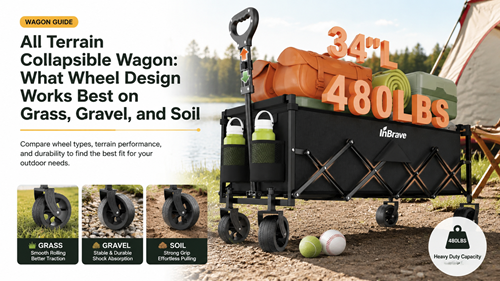
An all terrain collapsible wagon is defined less by the phrase on the box than by how its wheels carry a real load across the surfaces in your yard. Grass, loose gravel, compacted soil, mulch paths, and pavement place different demands on wheel diameter, width, tread, bearings, and steering geometry.
A wheel that rolls easily on concrete can dig into soft ground. A very wide wheel can float better on sand or lawn but make the cart heavier and harder to store. The right design balances terrain performance with turning control and folded size.
How an All Terrain Collapsible Wagon Handles Different Surfaces
Wheel diameter helps a cart climb over small stones, roots, edging, and shallow ruts because the wheel approaches obstacles at a shallower angle. Width spreads the load over more ground and can reduce sinking.
Tread can help on loose material, but aggressive patterns also trap mud and gravel. Bearing quality and axle alignment influence rolling effort even when the wheel looks impressive.
Steering is part of terrain performance. Swivel front wheels improve maneuverability on hard surfaces but can shimmy or dig sideways in loose ground if they are too small or overloaded.
Six Wheel and Terrain Checks
Compare Wide Wheel Designs
wide wheels for garden wagon can reduce sink on soft lawn when the tire profile spreads the load without making the frame excessively wide.
Measure overall wheel-to-wheel width if the wagon must pass through narrow gates.
Test on Gravel Paths
A utility cart for gravel paths benefits from larger wheels and secure hubs that roll over loose stones instead of stopping abruptly.
Slow down on turns because gravel can shift under the outer wheels.
Check Grass Performance
A folding wagon for grass should be tested with a normal load because wet lawn creates far more rolling resistance than dry pavement.
If the wheels leave deep tracks, reduce the load or choose a wider tire.
Evaluate a Terrain-Ready Frame
A terrain ready yard cart needs enough frame stiffness that the bed does not twist when opposite wheels cross uneven ground.
Frame flex can make steering feel vague and can shift tall loads.
Look for Useful Traction
garden cart wheel traction matters most when starting, stopping, or turning on loose surfaces rather than while coasting on flat pavement.
Tread should be easy to clean if the wagon moves between soil and a garage or vehicle.
Plan for Rough Ground
A portable wagon for rough ground should remain controllable when one wheel crosses a rut or root instead of transferring a sudden twist to the handle.
Keep the load low and centered to reduce tipping force on uneven terrain.
Wheel Design by Surface
Different surfaces reward different wheel characteristics.
| Surface | Useful Wheel Trait | Main Limitation |
|---|---|---|
| Concrete | Smooth rolling and easy swivel | Small wheels catch on edges |
| Grass | Wider profile and larger diameter | Wet turf increases drag |
| Loose gravel | Large diameter and stable hub | Sharp stones increase vibration |
| Compacted soil | Moderate tread and strong wheel | Ruts can twist the cart |
| Mulch path | Wide wheel and low load | Loose mulch can build around hubs |
| Slope | Brake or strong parking control | Load can push the wagon downhill |
Run a Mixed-Surface Test Before Heavy Use
Load the wagon to a moderate real-world weight and follow the exact garden route. Include a start on grass, a gravel turn, and any threshold into a garage or shed.
Note whether the handle remains comfortable, wheels sink, front casters flutter, or the bed twists. Those observations define practical terrain capacity better than an unloaded test.
Terrain Test Sequence
- Inflate tires if required
- Load heavy items low
- Start on firm ground
- Cross lawn at walking speed
- Turn on loose gravel
- Cross one small rut
- Test parking on a slope
- Inspect hubs after the route
Do not force a cart through terrain that repeatedly stops the wheels. Choose a different route, lower the load, or use a more suitable cart design.
Wheel Care for Dirt and Gravel
Remove string, roots, and packed soil from axles and caster areas. Check fasteners and tire condition because rough ground creates more vibration than smooth pavement.
Store the wagon clean and dry. If pneumatic tires are fitted, use the pressure range specified by the manufacturer rather than guessing.
An official Gorilla Carts manual illustrates how load distribution, tire pressure, speed, and pre-use inspection are handled for a heavy garden cart; see the manufacturer safety instructions.
Who Needs an All-Terrain Wagon
This design is most useful for larger yards with a mixture of lawn, gravel, soil, and paved areas, especially when supplies move regularly between distant beds.
If the route is entirely smooth patio or driveway, lighter small-wheel carts can be easier to fold and store. Pay for terrain capability only when the property actually requires it.
Choose All Terrain Collapsible Wagon Wheels for the Worst Surface
An all terrain collapsible wagon should be evaluated on the hardest section of the route, not the easiest. Wheel diameter, width, tread, steering, frame stiffness, and load placement all affect performance.
Test with a realistic load and choose the model that stays controllable without excessive pulling force or wheel sink.
Frequently Asked Questions
Are wider wagon wheels always better on grass?
They can reduce sinking, but they also add width and weight. Overall design and load still matter.
Do pneumatic tires work better on gravel?
They can absorb vibration and roll well, but they require pressure checks and can puncture.
Why do swivel wheels struggle in loose soil?
Small casters can rotate sideways and dig in instead of tracking straight under load.
Should I use the maximum rated load on rough terrain?
A lower practical load is often easier and safer on uneven ground. Follow manufacturer guidance.
Are brakes important on an all-terrain wagon?
They are useful when parking on slopes or during loading, but they do not replace control while moving downhill.
