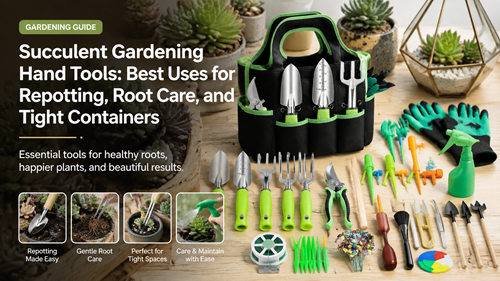
Succulent gardening hand tools are smaller than general garden tools because the work is different. Repotting a three-inch rosette, clearing old mix from fine roots, or adding gritty soil around a cactus requires precision and control rather than leverage.
The best kit may include a narrow trowel, small scoop, tweezers, soft brush, transplanting stick, and compact rake, but every piece should solve a real task. Tiny tools should still be rigid enough to move dry mix without bending.
How Succulent Gardening Hand Tools Improve Precision
Small containers leave little room between the plant, root ball, and pot wall. A standard trowel can damage leaves or spill more mix than it moves. Narrow tools allow controlled placement around the plant.
Succulent and cactus mixes are often coarse and fast draining. A scoop with a deep bowl can transfer grit and bark more cleanly than a flat planting blade.
Root work requires restraint. The goal is not to comb every root apart. Use small tools to remove loose dead material and position the plant without tearing healthy roots unnecessarily.
Six Small-Tool Features to Compare
Size Tools for Repotting
mini tools for succulent repotting should fit between the root ball and pot wall without crushing leaves or forcing the plant off center.
A range of two or three widths is more useful than several identical miniature trowels.
Protect Fine Root Systems
small plant root care tools should have smooth edges and enough stiffness to loosen mix gently without snagging roots.
Use a chopstick-style tool or narrow transplanter for controlled gaps rather than prying with the plant stem.
Work Around Cactus Spines
precision cactus potting tools are most useful when they reduce hand movement close to spines and let you place mix from the side.
Tools do not replace appropriate gloves or tongs for species with hazardous spines.
Use a Narrow Container Trowel
A tiny trowel for containers should carry enough mix to be efficient while still entering the pot without hitting the plant.
A curved or narrow blade can help direct soil into gaps around the root ball.
Control the Soil Scoop
A succulent soil scoop set is useful for gritty mixes when the scoop edges do not catch on pot rims and the handle gives good fingertip control.
If a scoop is too deep for tiny pots, use a smaller spoon-shaped tool rather than overfilling the container.
Keep the Kit Compact
compact indoor planting instruments should store in a small tray or pouch near the potting area so they are easy to clean and do not disappear among full-size garden equipment.
A dedicated indoor set also reduces the chance of bringing outdoor soil and debris to a clean potting bench.
Tool Choice by Succulent Task
Match each tool to a precise job rather than choosing by kit size.
| Task | Useful Tool | Control Needed |
|---|---|---|
| Move dry mix | Mini scoop | Avoid spilling over pot rim |
| Set planting depth | Narrow trowel | Keep crown at correct level |
| Clear roots | Tweezers or narrow pick | Remove debris without tearing roots |
| Position stems | Blunt planting stick | Support without piercing tissue |
| Finish surface | Soft brush | Remove soil from leaves |
| Work near spines | Long tweezers or tongs | Keep hands farther away |
Repot With a Clean, Ordered Workspace
Prepare the new pot, dry mix, tools, and a tray before removing the plant. An organized surface reduces the time roots remain exposed and keeps gritty mix from spreading through the room.
Use tools to support the plant rather than pull it. If the root ball is stuck, work around the container edge and loosen it gradually.
Succulent Repotting Setup
- Choose a pot with drainage
- Prepare fresh suitable mix
- Clean the small tools
- Protect hands from spines
- Remove the plant gently
- Inspect roots in good light
- Backfill with a narrow scoop
- Brush mix from leaves
Water timing after repotting depends on the plant, root condition, and growing medium. Follow species-appropriate care rather than applying one rule to every succulent.
Clean Precision Tools Between Plants
Fine soil and organic debris collect easily in tweezers, scoops, and narrow trowels. Brush them clean and dry metal tools before storage.
Disinfect tools when disease is suspected and avoid using sharp picks on healthy roots without a clear need. Precision should reduce damage, not encourage unnecessary root disturbance.
Penn State Extension provides a practical overview of containers, potting media, and repotting technique in Repotting Houseplants.
Who Needs a Dedicated Succulent Tool Kit
A small kit is worthwhile for collectors who repot many succulents, work with miniature containers, or arrange mixed planters where full-size tools are cumbersome.
For one or two large succulents, a standard small trowel, spoon, and clean tweezers may be enough. Buy the kit when repeated precision work justifies dedicated pieces.
Choose Succulent Gardening Hand Tools for Control, Not Quantity
Succulent gardening hand tools should make repotting cleaner and more precise. Narrow scoops, trowels, tweezers, and brushes are valuable when they fit the container and reduce unnecessary contact with roots and leaves.
Build the kit around the plants you own, keep every piece clean, and use the least force needed for each step.
Frequently Asked Questions
Do I need special tools to repot succulents?
Not always, but narrow scoops and tweezers make small containers and delicate plants easier to manage.
What is the best tool for adding gritty mix?
A small deep scoop or narrow trowel that fits the pot opening gives good control.
Should I loosen every succulent root during repotting?
No. Remove loose or dead material as appropriate and avoid tearing healthy roots unnecessarily.
How do I keep soil off succulent leaves?
Use a soft clean brush after backfilling rather than wiping delicate leaves repeatedly.
Can the same tools be used for cactus plants?
Yes in many cases, but use appropriate hand protection and longer tools around hazardous spines.
